Tuesday, 8 March 2016

Probably my last post from the Holy Land

Jerusalem from Dominus Flevit
The Tantur programme is drawing rapidly to a close. And I have to say it has been great. I'm sure I'll be reflecting on the experiences of walking where Jesus lived and walked for a long time - and probably driving everyone mad with my reminisces!

There's a view of the Dome of the Rock behind
Sunday morning a group of us went to Dominus Flevit - "The Lord Wept" to celebrate Mass there. They put up the ropes so no-one could get in during Mass, and just as well. A large party of Asian tourists squashed up to the door and almost blinded us with their flashes! I had a laugh at the thought of being "local colour" for their holiday snaps. I remembered all of you back home during Mass - I hope you felt the vibes!

 Four of us bundled into a taxi on Sunday afternoon to go to Bethany. You'll remember that Jesus had some friends there - Martha, Mary and Lazarus. And that he visited them and Martha complained about Mary sitting around doing nothing while she did all the work. And then later how Jesus, while in Jerusalem was informed that Lazarus had died, waited a couple of days and then went and resurrected him.

Bethany from the Bethphage on the Mount of Olives

The taxi ride took us about 40 minutes to get to a dusty Arab town. We had much earlier spotted it from Bethphage on the Mt of Olives. It's really just a stone's throw from Jerusalem and it is thought that Jesus may have stayed with his friends when he went up to Jerusalem to the Temple.

Mosaics from the 1st century CE - protected from all the elements except water!

Modern Bethany is largely Moslem now, but the Christians maintain a toehold there. The church is a recent one built in 1954, but there are the remains of two older churches.

The columns from the Crusader Church
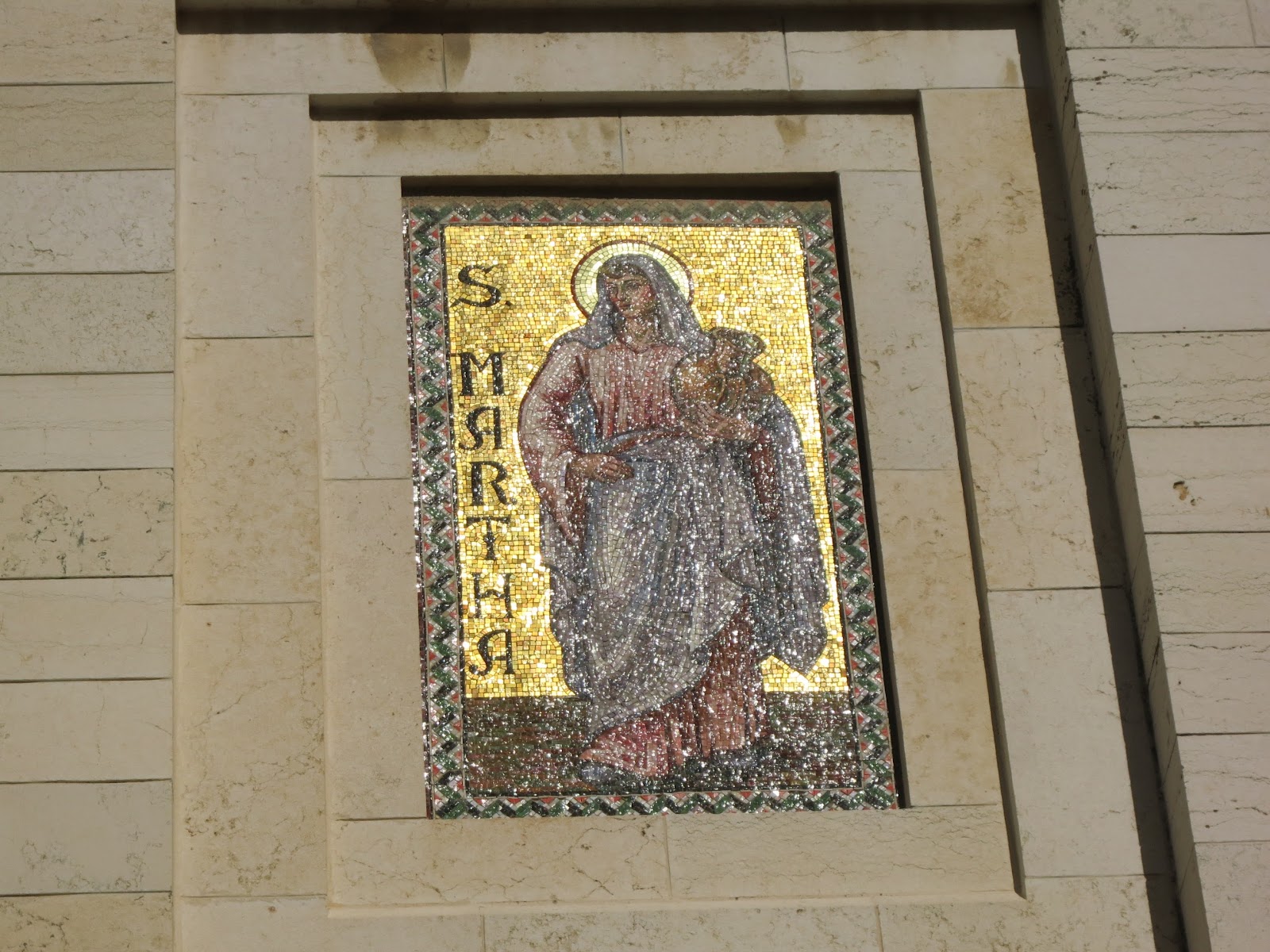
In a corner are the mosaics that date from the 1st century CE. And ruins of the other churches from the 6th and 12 centuries. The wall of the modern church has a couple of nice modern mosaics of the three siblings.


But the real attraction is the cave said to be the tomb of Lazarus. The original entrance, now blocked up, is in the mosque, with the vestibule where Jesus called to Lazarus to come out. The alternative entrance is from the street. It is a real tomb - a bit scary and claustrophobic. 

The "new" entrance

The cross scratched where Lazarus was laid

Eric happy to be coming out of the tomb!

A plaque on the wall of the tomb

It was really interesting to visit, and a little moving too. I was glad to get out of the tomb. As I imagine Lazarus was too!

We hopped back into the taxi for another 40 minutes ride back to Tantur. The reason it takes so long is that the Israelis have divided Bethphage from Bethany by the Separation Wall. What used to be a ten minute stroll down the Mt of Olives across the Kidron Valley now is a large detour around the wall and through a check-point. This, of course, makes it difficult for the people of Bethany to go to work in Jerusalem, and perhaps worse, very difficult for tourists to visit Bethany. This, in turn, impacts on the economy of the village. The owners of the handicraft stores were desperate for us to visit - and buy something. It would be good for Vice-President Biden of the US (at present visiting Jerusalem) to go and visit Bethany. He might see that his government's unqualified support for some of Israel's "security" plans has a real negative impact on thousands of people here and in other places.

Monday, 7 March 2016

Jerash and back to Israel

Hadrian's gate - built to commemorate his visit in 130 CE
This morning we traveled to the ancient Greco-Roman city of Jerash near Amman. The city was probably founded by Alexander the Great or one of his general as a settlement for his ex-soldiers in 331 BCE. It was one of the Decapolis.

The South Theatre


detail of grapes, pine and pomegranate 

The oval shaped central forum


A contemporary performance in the theatre

A Jordanian Bagpiper


Cross street - across the Cardo 

Byzantine Church mosaic floor


Thermal Baths - built by Bishop Placus c 451 CE

Capitals

The temple of Artemis

Steps up to the temple of Artemis

The Cardo - central street

fallen decorations from the colonnade.

The Cathedral built by Bishop Placus recycling bits of Artemis' temple
The entrance to the Cathedral

It flourished and grew, begin added to by the emperors Trajan and Hadrian. Overrun by the Persians the city went into a decline but it grew under the Umayyad dynasty. It finally was destroyed by and earthquake in 749 CE.


The Marcellum or food market

A lion in the food market
A calf in the food market - a butcher's stall?
a local weed - model for the capitals

detail of a capital


Medusa

The Cardo - the main street
After lunch we headed back to the border, crossing at Sheik Hussein Border. It took us an hour and a half to complete the formalities. This included on the Jordanian side at least three separate checks of our passports, scanning of our bags, several stamps, a ride in a shuttle bus to the Israeli side. The bus was examined underneath, our bags were scanned (as we were), our passports examined and we were interrogated about our trip to Jordan and who we were and where we had been. The immigration man there, good humouredly, tried to trip me up by saying New Zealand was one island and part of Australia wasn't it? At least I think it was a trick... After crossing, and having an ice-cream we boarded yet another bus for the trip back to Jerusalem. The trip was a couple of hours. We crossed closer to Galilee than Jerusalem.


I have seen the Promised Land!

The monument at Mt Nebo

Today we headed up Mt Nebo. It is somewhere near here that Moses saw the promised land, died and was buried. The remains of a Byzantine (late 4th century) church were discovered here. The mosaics and church are being restored.
Standing on the edge of Mt Nebo - Israel in the distance

Looking toward the Dead Sea
We celebrated Mass in the small chapel of the Franciscan Friars. John, a Franciscan Friar, presided!


Modern Mosaic in the Chapel

St Joseph

Christ, Pantocrator - modern mosaic

The church was built over the Byzantine church, which has some amazingly complete mosaics. The church is closed while it's being renovated (it will open soon), but if one is fortunate...


Just before we were thrown out!
From there we headed for Bethany beyond the Jordan for lunch. Afterwards we had a walking tour come reflection with a Lutheran Pastor and his wife along the banks of the Jordan river.

Interior of the Lutheran Church


The Jordan River (and the border) is between the far churches and the scrub in front of the buildings at the bottom.
Lunch was at the Russian Pilgrim House - complete with large photos of Mr Putin who supported the building of the place. Nearby is the shell of a huge, cathedral sized Catholic Church under construction. It looks like a bit of "mine is bigger than yours".

John the Baptist spring

An ancient baptismal pool

The scrub in the area

A trail through the bush, as it must have been in Jesus' time

The Chapel of the Jordan River
The actual place thought to be where Jesus was baptised by John is marked by the ruins of three churches, one replacing the other and stone steps leading down to where the Jordan used to flow. The actual place is the pillar with the roof over it where a metal cross is set into a marble column. The chapel is built over where Jesus was thought to have disrobed to be baptised.
Not that happy about being photographed! That is Israel across the Jordan and the Israeli effort to syphon off some baptismal tourism

The Jordan

The Catholic Church of John the Baptist under construction


At an alternative baptismal site
After a time of prayer and reflection we headed on to Amman, the capital of Jordan.